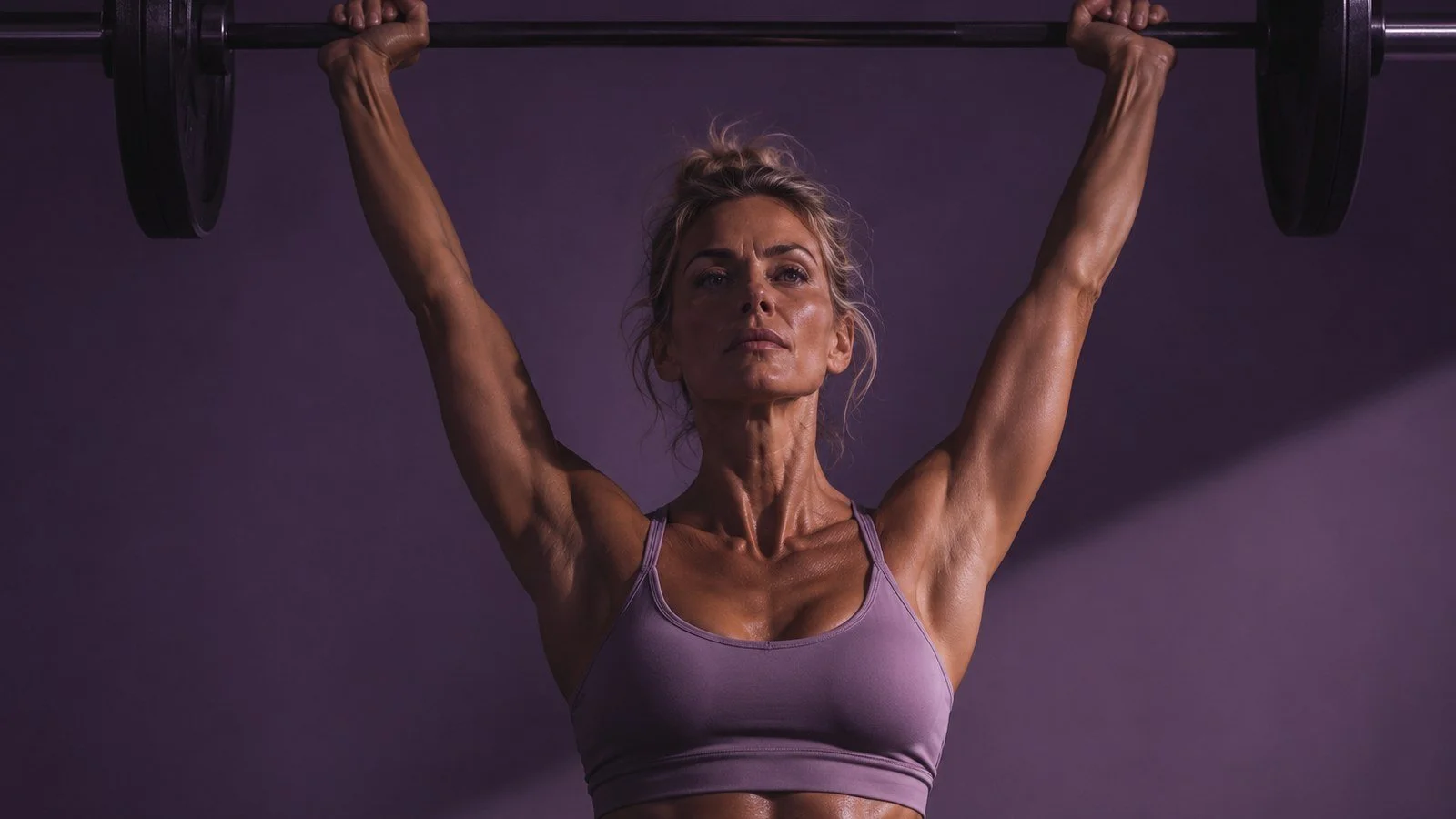
Never Touched a Barbell?
A Beginner's Guide to Weights for Women Over 40
Nov 17, 2026 · @HOTFLASH
Let's get one thing straight: a barbell is a metal stick. It doesn't know your age, it doesn't judge your leggings, and it has never once rolled its eyes at a beginner.
If you're a woman over 40 who has never touched a weight, I'd bet the weights section of the gym feels like a party where everyone else got the invitation. Here's the secret: nobody in there is looking at you. They're looking at their own reflection, their phone, or both.
This beginner's guide to weights for women over 40 is for you if you've ever thought "I'm too old," "I'll bulk up," or "I wouldn't even know where to start." The research says you're not too old. You won't wake up looking like a bodybuilder. And starting is simpler than you think.
Below, I'll walk you through what strength training does for women in perimenopause, menopause and post-menopause (on the inside and the outside), what your first session actually looks like, and how to start in Savannah, GA without feeling like the only person who doesn't know what a Smith machine is.
Why Strength Training for Women Over 40 Matters
Starting around age 30, muscle mass slowly shrinks, by roughly 3% to 8% per decade according to one review of sarcopenia (age-related muscle loss) in menopausal women [1]. Nobody sends you a notification. You just notice that the jar lid is harder, the stairs feel steeper, and the suitcase that used to be "light" now has opinions.
Then menopause enters the chat. Researchers suspect the drop in estrogen may play a part in how fast women lose muscle, although a 2026 review in the Journal of Cachexia, Sarcopenia and Muscle notes that high-quality evidence linking the two is still limited [2]. What that same review is clear about: resistance training is the most effective way we have to fight age-related muscle loss [2].
That's why the World Health Organization recommends muscle-strengthening activities on two or more days a week for all adults [3]. Two days. Not seven. Not "move into the gym and eat your meals there." Two.
What Lifting Weights Does on the Inside
The benefits of weight training for women over 40 go well beyond muscle. Here's what the research says about the parts of you nobody can see.
Stronger bones
Bone responds to being loaded, which is a fancy way of saying it gets stronger when you ask it to do real work. In the LIFTMOR trial, 101 postmenopausal women with low bone mass (average age around 65) did 30-minute supervised heavy-lifting sessions twice a week for eight months. Their lumbar spine bone density rose by about 2.9%, while the comparison group, who did low-intensity home exercise, lost about 1.2% [4]. That was a carefully supervised program with no adverse events reported, which is exactly why learning to lift properly with a trainer beats winging it with YouTube and optimism.
A happier heart (and a longer life)
A 2022 meta-analysis of 16 studies in the British Journal of Sports Medicine found that muscle-strengthening activity was associated with a 10% to 17% lower risk of death from any cause, heart disease, cancer overall and diabetes. The sweet spot showed up at around 30 to 60 minutes a week [5]. That's a lunch break, not a lifestyle. These were observational studies, so they show a link rather than proof, and the authors call for more research. Still, 30 minutes is a very low-price lottery ticket.
Better moods and less anxiety
A 2018 meta-analysis in JAMA Psychiatry pooled 33 randomized trials with 1,877 participants and found that resistance training was associated with a significant reduction in depressive symptoms, with a moderate-sized effect [6]. A separate systematic review found that resistance exercise was also linked to less anxiety [7]. Lifting is not a replacement for medical care or support, but it is a seriously good teammate on the days your moods are doing the cha-cha.
Better sleep
That same systematic review of 13 randomized trials found that regular resistance exercise improved all aspects of sleep, with the biggest benefit for sleep quality [7]. Translation: the cheapest bedtime routine on earth involves a dumbbell, not a screen.
What Lifting Weights Does on the Outside
Yes, the outside matters too, and no, you don't have to pretend it doesn't. Here's what women tend to notice first.
Everyday strength. Carrying groceries in one trip, lifting a suitcase into the overhead bin, getting up off the floor without a negotiation. In the LIFTMOR trial, the lifting group improved on every functional test, including sit-to-stand and back and leg strength, and even finished slightly taller than they started [4].
Posture. Strengthening your back and shoulders is the closest thing to a free upgrade for how you stand. Shoulders back, chin up, instant confidence.
Shape. Building muscle changes how your body looks and fits into your clothes, often more than the number on the scale does. Weight loss can be part of the story, but it doesn't have to be the headline.
Energy and confidence. Doing something you were nervous about, and doing it well, is its own kind of fuel. You walk out of the gym taller than you walked in. That's not a metaphor. Okay, partly it's a metaphor.
What Your First Session Looks Like in Savannah
Your first session is mostly about getting comfortable, not getting wrecked. Nobody hands you a barbell and says "good luck."
At Fit Gym in Sandfly, I start with a friendly tour, so you know what the machines, weights and benches are for. Then we practise a few basic movements, starting light, until they feel natural. You'll leave knowing what to do next time, which is the whole point.
Sessions last one hour, and you can train one-to-one, with a partner or in a group of three. Bringing a friend or family member is encouraged, because laughing through your first squats together beats doing them alone. Total beginners are very welcome. If you've never lifted anything heavier than grocery shopping, you're in the right place. Also, there is the option to just initially learn the ropes and then go it alone - if you’re self motivated then this is the route for you!
Three Myths About Weights for Women Over 40
Most of the fear around lifting comes from three myths. Let's retire them.
"I'll bulk up." Building large muscles takes years of very deliberate heavy training and eating, and women have far lower testosterone than men. A beginner program makes you stronger and firmer, not suddenly enormous. If it were that easy, every gym would be full of surprised people.
"I'm too old to start." The women in the LIFTMOR trial were around 65, had low bone mass, and got stronger anyway [4]. You're not behind. You're on time.
"I need to lose weight or get fit first." That's like tidying before the cleaner comes. The WHO's advice is that some activity is better than none, and that you start with small amounts and build up gradually [3]. Beginners are who a beginner program is for.
Ready to Pick Up Your First Weight?
You don't need to feel ready. You just need to show up once, which is the hardest rep there is.
If you're in Savannah, GA, I'd love to be the female personal trainer standing next to you for it. Book a one-hour strength training session at Fit Gym in Sandfly, on your own, with a friend, or in a group of three. Prefer to talk first? My one-hour online menopause consultation looks at the bigger picture: sleep, nutrition, exercise and everything in between.
As with any new exercise program, check with your doctor first if you have a health condition or any concerns. Then come say hi to the metal stick. It's been waiting.
References
Sarcopenia in Menopausal Women: Current Perspectives. Int J Womens Health. 2022;14:805-819. doi:10.2147/IJWH.S340537
Menzies C, Bowtell R, Shur N, Brook MS. Menopause, Female Sex Hormones, Skeletal Muscle Mass and Muscle Protein Turnover in Humans. J Cachexia Sarcopenia Muscle. 2026. doi:10.1002/jcsm.70232
Bull FC, et al. World Health Organization 2020 guidelines on physical activity and sedentary behaviour. Br J Sports Med. 2020;54(24):1451-1462. bjsm.bmj.com
Watson SL, Weeks BK, Weis LJ, Harding AT, Horan SA, Beck BR. High-intensity resistance and impact training improves bone mineral density and physical function in postmenopausal women with osteopenia and osteoporosis: the LIFTMOR randomized controlled trial. J Bone Miner Res. 2018;33(2):211-220. doi:10.1002/jbmr.3284
Momma H, Kawakami R, Honda T, Sawada SS. Muscle-strengthening activities are associated with lower risk and mortality in major non-communicable diseases: a systematic review and meta-analysis of cohort studies. Br J Sports Med. 2022;56(13):755-763. doi:10.1136/bjsports-2021-105061
Gordon BR, McDowell CP, Hallgren M, Meyer JD, Lyons M, Herring MP. Association of efficacy of resistance exercise training with depressive symptoms: meta-analysis and meta-regression analysis of randomized clinical trials. JAMA Psychiatry. 2018;75(6):566-576. doi:10.1001/jamapsychiatry.2018.0572
Kovacevic A, Mavros Y, Heisz JJ, Fiatarone Singh MA. The effect of resistance exercise on sleep: a systematic review of randomized controlled trials. Sleep Med Rev. 2018;39:52-68. doi:10.1016/j.smrv.2017.07.002